


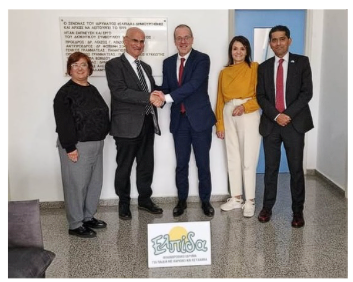

Prof. Loizos G. Loizou (third from left) with members of the Paediatric Oncology/Haematology team at Archbishop Makarios III Hospital, Nicosia, in 2021 — the team behind more than three decades of dedicated care for children and adolescents with cancer in Cyprus.“The Sick Child Is Our King”: Dr Loizou Reflects on 36 Years on the Front Line Against Childhood Cancer
Interview by Georgia Michael, Cyprus Times
Published: 2 August 2026
For more than 36 years, paediatric oncologist Dr Loizos Loizou has been on the front line of the fight against childhood cancer.
In this wide-ranging interview with Georgia Michael for Cyprus Times, he reflects not only on the remarkable advances in science and the high cure rates that can now be achieved, but also on some of the most difficult moments a doctor can face: standing beside a child with cancer and their family during the course of a life-threatening illness.
Dr Loizou discusses the development of paediatric oncology in Cyprus, the country’s international recognition in the field, the potential of artificial intelligence, conspiracy theories surrounding cancer, the invaluable lessons he has learned from his young patients, and the fundamental importance of honesty and trust in medicine.
What led you to choose paediatric oncology? It is an important and essential field of medicine, but one that also carries an enormous emotional burden.
I chose medicine because I wanted to serve people—to do something useful and beneficial for society. I chose paediatrics because I loved children.
As I progressed through my training and became familiar with the different subspecialties, I came across an area in which there was an enormous unmet need. This was in the late 1970s and early 1980s, when the first major successes in paediatric oncology were beginning to emerge.
One experience in particular had a profound effect on me. As a young doctor training in Brussels, I encountered a 16-year-old girl who, unfortunately, had to undergo an amputation because of bone cancer. I watched the doctors fighting to help her, and the experience made a lasting impression on me.
Gradually, while training in paediatrics, I became increasingly involved in this field. There was a great need and, therefore, a great opportunity to contribute.
It is undoubtedly a difficult and painful specialty, both psychologically and scientifically. It is particularly complex because we care for children of very different ages—from infants to adolescents and young adults.
Emotionally, it can be extremely demanding. As doctors, we are trying to treat serious diseases in children—the most precious people in our lives.
Scientifically, it is also a highly complex field because childhood cancer is not a single disease. It encompasses hundreds of different diseases, each with its own biological and clinical characteristics.
Cancer, by its very nature, is unpredictable. We are dealing with different diseases at different stages of childhood. A cancer occurring in an infant is very different from one occurring in a young child or an adolescent. Internationally, paediatric oncology may also extend into the young-adult age group.
Nevertheless, I felt that this was an area in which I could make a contribution. Of course, I faced my own challenges along the way, but gradually I learned to approach them as a physician.
Our purpose is to help our fellow human beings—and all the more so when those human beings are children. That is why I devoted myself to this field.
Is it understandable that, even today, the word “cancer” still frightens people?
Historically, that fear has been a reality. Fortunately, however, over recent decades we have seen major improvements in cure rates, both in children and adults.
There are now cancers that can be completely cured.
In children living in developed countries such as Cyprus, cure rates now exceed 82–85%. In adults, outcomes are also continuously improving, with overall figures reaching approximately 50–60%.
As a result, the fear traditionally associated with cancer is gradually beginning to diminish.
What was paediatric oncology like in Cyprus when you began, and what is the situation today?
In 1987–88, the then Minister of Health, Dr Papageorgiou, approached me because there was a major unmet need in Cyprus. At that time, there were no organised services for children with cancer, leukaemia and related diseases. There was essentially no organised paediatric oncology service.
I was working in France in this field at the time. Following his invitation, I returned to Cyprus in 1989 so that we could establish the necessary services.
Today, 36 years later, we can be proud of what Cyprus has achieved.
Primarily through our own efforts—but also, particularly during the early years, with assistance from other countries—we created the services we have today.
It was something we achieved collectively: as a society, as a state and as healthcare professionals.
Cyprus has now achieved a great deal in this field. We are among the countries with some of the highest cure rates for children with cancer.
We are also one of a relatively small number of countries worldwide to have developed a strong, high-quality, population-based cancer registry specifically covering children and adolescents.
This is extremely important because it allows us to evaluate everything that has been achieved. We can study cancer incidence, trends over time, geographical distribution, survival, mortality and, to a certain extent, the quality of life of childhood cancer survivors.
So, after 36 years, Cyprus has progressed from almost nothing to a level of care of which we can genuinely be proud. In many areas, we have nothing to envy in the highly developed countries of the Western world.
There are, of course, certain highly specialised procedures that we cannot reasonably provide because Cyprus is a small country—for example, allogeneic bone marrow transplantation, certain highly complex neurosurgical procedures and some other specialised interventions.
Could these treatments eventually be provided in Cyprus as well?
Not necessarily, because the numbers of patients requiring them are very small.
We have to recognise both our strengths and our limitations. We know what we can do and what we cannot do. When something cannot be appropriately provided in Cyprus, we refer the child abroad.
When you have only three or four such cases per year, it may not be justified to establish a particular highly specialised service locally. It is often better to send these patients to major European centres—for example in Germany or France—where they treat far larger numbers of cases and therefore have much greater experience.
One of the most important things in medicine is to know what you can do—and what you cannot.
Much of what we have achieved in Cyprus was possible precisely because we understood where we had the capacity to succeed.
Another success has been a personal one. Once again, you have received international recognition as one of the prominent figures in oncology. What does such a distinction mean to you and to Cyprus?
I see it as an honour for Cyprus as a whole.
I believe each one of us should regard ourselves, in a sense, as a representative of our country and our society.
Wherever we work, we should try to do the best we possibly can and contribute to the community. It is important to recognise our abilities, use them to help other people and collaborate with others who share the same philosophy.
In this way, we can create positive centres of activity within society that produce meaningful results.
If that work is carried out with love and passion, recognition may eventually follow. But the work should be done without complaining, without unnecessary criticism and always with the common good in mind.
In my own case, I have been internationally active for many years, and particularly intensively during the last three years through Cyprus’s International Action Plan for Children and Adolescents with Cancer.
We are undertaking numerous activities in many countries, focusing on three principal areas: public education, education and training of healthcare professionals, and the provision of treatment and medical support.
For a small country, Cyprus has developed a remarkable international presence.
Over the past three years, our work has gained worldwide visibility. Any recognition I personally receive stems largely from these initiatives because I helped conceive and lead them—but they are very much the result of collaboration among many people and organisations.
These include the Cyprus Medical Association, the Cyprus Paediatric Society, the medical schools of the University of Nicosia and European University Cyprus, and AHEPA.
We also collaborate with the French group working to support children with cancer in Africa.
The Ministers of Health and Foreign Affairs, as well as the President of the Republic, have also contributed to these efforts.
Together, as Cyprus, we are working to help children with cancer and other devastating diseases.
Cyprus can become a hub and a beacon for humanitarian and medical assistance, the transfer of expertise, and the generation of knowledge.
And something else is very important: by giving to others, we ourselves learn enormously.
Turning to technology and the rapid development of artificial intelligence, how do you think AI will change oncology?
It is an extraordinary development.
I would even describe it as a gift from God to humanity.
We need to learn how to use artificial intelligence. It should become a horizontal skill, accessible to everyone.
AI is a tool we should not fear. It is up to us to understand it and learn how to use it appropriately in our everyday lives.
It will continue to develop rapidly, and we need to ensure that we use it for our own benefit and for the benefit of our fellow human beings.
We should not be afraid of it.
Could artificial intelligence help us eventually reach a point where 100% of childhood cancers can be cured?
Artificial intelligence is one of the many “weapons” now available to us.
Together with the others, yes, it can help us move towards that goal. But AI alone cannot achieve it.
There are already several forms of cancer in children and adolescents for which cure rates today approach 100%.
However, there are other cancers—for example certain brain tumours—where progress has unfortunately been much slower, and overall cure rates remain around 60–65%.
By combining modern technologies—advanced surgery, microscopy, molecular biology and other scientific developments—with everything that artificial intelligence can contribute across these fields, AI can become another important part of our effort to improve cure rates.
It is like having an adviser, supporter and assistant available 24 hours a day.
As one of the specialists in this field, how do you respond to people who ask: “How can humanity have reached the Moon and yet still not have found a cure for cancer?”
I understand those people. I can put myself in their position and understand what they are feeling.
But what I would add to their understanding is that travelling to the Moon and defeating cancer are fundamentally different challenges.
First of all, there is no single disease called “cancer”. There are thousands of different forms of cancer, each with its own particular characteristics.
And human beings themselves are different.
As we said earlier, a newborn infant is very different from an elderly person diagnosed with cancer.
We must not compare things that are fundamentally incomparable.
There is no conspiracy. Such a conspiracy would simply be impossible.
Some people take that argument further and suggest that financial interests may be involved.
Quite the opposite.
If someone possessed a drug capable of curing every cancer, the person or company that discovered it would be the first to want to make it available.
The argument simply does not stand up.
There is no evidence supporting such claims or implicating anyone in such a conspiracy. In all my years working in this field, I have never seen anything that would suggest otherwise.
And think of the scale that such a conspiracy would require: thousands—indeed perhaps millions—of scientists, researchers, doctors, directors and pharmaceutical executives all agreeing to conceal the same thing.
That is simply not credible.
Another thing that people often find difficult to understand is how a child can develop cancer before having had the chance even to experience life. It may seem easier to understand cancer in an adult, where lifestyle or previous exposures may sometimes have contributed.
This goes back to what I said earlier: we are talking about completely different diseases.
Lung cancer, for example, is strongly associated with smoking. Its biology and causes are very different from those of a leukaemia arising in a newborn baby, or thyroid cancer occurring in an adolescent.
Not every cancer is related to preventable exposures or carcinogenic factors.
Cancer is an enormous and highly heterogeneous group of diseases.
Leaving Dr Loizou the physician aside for a moment and speaking to Loizos the person: among the thousands of children you have treated, is there one case you will never forget?
Every child is unique.
Every child has their own personality.
The philosophy we have always followed at the Paediatric Oncology/Haematology Department of Archbishop Makarios III Hospital, together with its excellent doctors, is very simple:
The sick child and their parents are our king. We are there to serve them.
Every child therefore has their own special character, their own grace and their own capacity to inspire affection.
Each is unique.
It would, of course, be difficult to discuss individual cases in detail, particularly from a medical perspective.
How do you cope with the loss of a child?
It is painful for all of us.
First and foremost, of course, for the parents, siblings and the entire family.
We have to help them deal with that pain.
Sometimes we know from the beginning that the prognosis is very poor—months or even years before the end comes.
As doctors, one of our first responsibilities is to give the family strength and to ensure that we provide the parents and siblings with the right support.
This requires a particular approach. It is not something you can learn solely from textbooks or lectures. It develops through many years of experience.
The loss of a child is one of the most devastating things that can happen to a human being.
Supporting these families is, of course, a team effort involving nurses, other doctors, psychologists and, at times, psychiatrists.
But we are human too. We have children and families of our own. We have our own emotional world, and we are hurt as well.
There are times when we suffer for weeks. You become so closely connected to these children and their families.
At the same time, when you choose this specialty, you know that, unfortunately, every year you will lose some children.
You know that this is part of the reality you will face. You have to be prepared for it. If you cannot accept that reality, then this is probably not the right specialty for you.
Were there ever occasions when you withheld the truth from parents? You mentioned that sometimes you knew from the beginning that a child might not survive.
No. Never.
Withholding the truth is a serious mistake, because it creates a lack of transparency and ultimately destroys trust.
In the past, there were doctors who did not necessarily lie, but who sometimes did not have the courage to tell patients or families the full truth.
The most important thing is that, from the very beginning, the doctor should explain the situation objectively, gently and without unnecessary pessimism, while always preserving hope.
Everyone needs to understand the real situation.
Of course, earning the parents’ trust takes time. But you must always tell the truth.
Imagine a parent eventually turning to you and saying, “Doctor, you never told me that this could happen.”
That has never happened to me, and I would never want it to.
At the beginning, you may sometimes appear harsh, and parents may be upset because you are speaking very directly. But in the end—even parents who have lost their children—may be grateful because they appreciate having known the reality from the beginning.
For example, I may tell them clearly that a particular disease is dangerous.
I explain all the possible scenarios.
A child may, for instance, lose their life not only because of the disease itself but also because of complications from treatment. Families need to know this.
I explain the possible courses the disease may take and indicate which one I believe is most likely. Usually, of course, the most likely outcome is the favourable one, but all realistic possibilities need to be discussed.
And the family must be part of the decision-making process.
Very often, adolescents—and sometimes even primary-school children—understand far more about what is happening than their families realise.
We therefore make decisions together, while clearly explaining what we, as doctors, recommend.
A doctor must devote the necessary time to explaining everything carefully to the child and the family.
What message would you like every family going through such an ordeal to hear from you?
Stay calm. We are entering a battle, and we are entering it to win.
Most forms of childhood cancer can now be cured.
Even in diseases for which the prognosis remains poor today, treatment continues to evolve so rapidly that there is always hope that, within the time the illness gives us, a new treatment may emerge that can offer a cure.
I have personally witnessed cases like this.
So we never abandon hope.
We proceed calmly and with a winner’s mindset.
We provide the best possible treatment. We communicate with the parents. We devote time to them and keep them fully informed.
At the same time, we continuously monitor developments around the world. Whenever something genuinely new becomes available that may benefit a child, we try to ensure that the child has access to it.
I am also proud that the Republic of Cyprus, at least throughout the period in which I have been involved in paediatric oncology since 1990, has never refused necessary treatment to a child with cancer.
We strive to provide the best possible care.
So my message to parents is:
Stay calm. Move forward with hope and strength, even in the most difficult circumstances.
We have an excellent team of doctors at Makarios Hospital doing outstanding work, and we have a state that does not leave anyone to face this journey alone.
What is the most important lesson your young patients have taught you?
They teach me something every day.
For me, both the children and their parents have been—and continue to be—an extraordinary school of life.
I am grateful for everything they have taught me in so many different ways.
A doctor can learn an enormous amount when they know how to listen and are willing to devote time and attention to their young patients.
Even very young children have valuable things to teach us.
Simply listening to their experiences helps us learn and makes us better able to care for them.
After so many years, what continues to give you the strength to carry on?
For me, all of this has become a way of life.
Lifelong learning. Love for humanity. The need to feel that you are contributing and that you are useful to another human being.
There is greater joy in giving than in receiving, particularly when you see that what you are doing is helping.
The greatest satisfaction comes from giving without expecting anything in return.
If you could send one message to the next generation of doctors, what would it be?
Let the human being be their king.
A doctor’s priority should be to learn not only how to treat disease, but also how to help people remain healthy.
The importance of prevention is enormous.
And, as I said earlier, the patient must always come first.
Doctors must give people their time.
A young doctor should have one overriding question in mind:
“How can I help this person overcome the physical or psychological health problem they are facing?”
If you start from that principle and truly make it part of who you are as a doctor, then you will succeed and you will be useful to society.
Every human being deserves our attention, whoever they may be.
From everything you have said, I imagine there was never a moment when you seriously considered leaving paediatric oncology?
No!
When I first began, I did think carefully about whether paediatric oncology was the path I wanted to follow. But once I had chosen it—no.
Not for a moment.
I am very happy that I have been able to contribute something to our society.
And if there is one final message I would like to leave with people, it is this:
Let us show love and care for our fellow human beings. Let us cultivate altruism, humanity, compassion and professionalism, with responsibility and integrity.
Let us give without expecting anything in return.
